1 December 2025, NIICE Commentary 11995
E. V. A. Dissanayake
The Island of Sri Lanka, struck by cyclone Ditwah, is facing the most destructive storms to hit the country in recent decades. Torrential rainfall, mass flooding, and landslides have devastated multiple districts, causing widespread casualties and displacement. As Sri Lanka grapples with a severe humanitarian crisis, India swiftly responded—deploying aircraft, naval assets, and emergency supplies under Operation Sagar Bandhu. This disaster, while tragic, also sheds light on the evolving nature of bilateral relations between Sri Lanka and India, revealing how humanitarian assistance, strategic proximity, and regional diplomacy intersect during times of crisis, within the broader context of bilateral political, economic, and security relations.
Cyclone Ditwah’s Impact and Humanitarian Emergency.
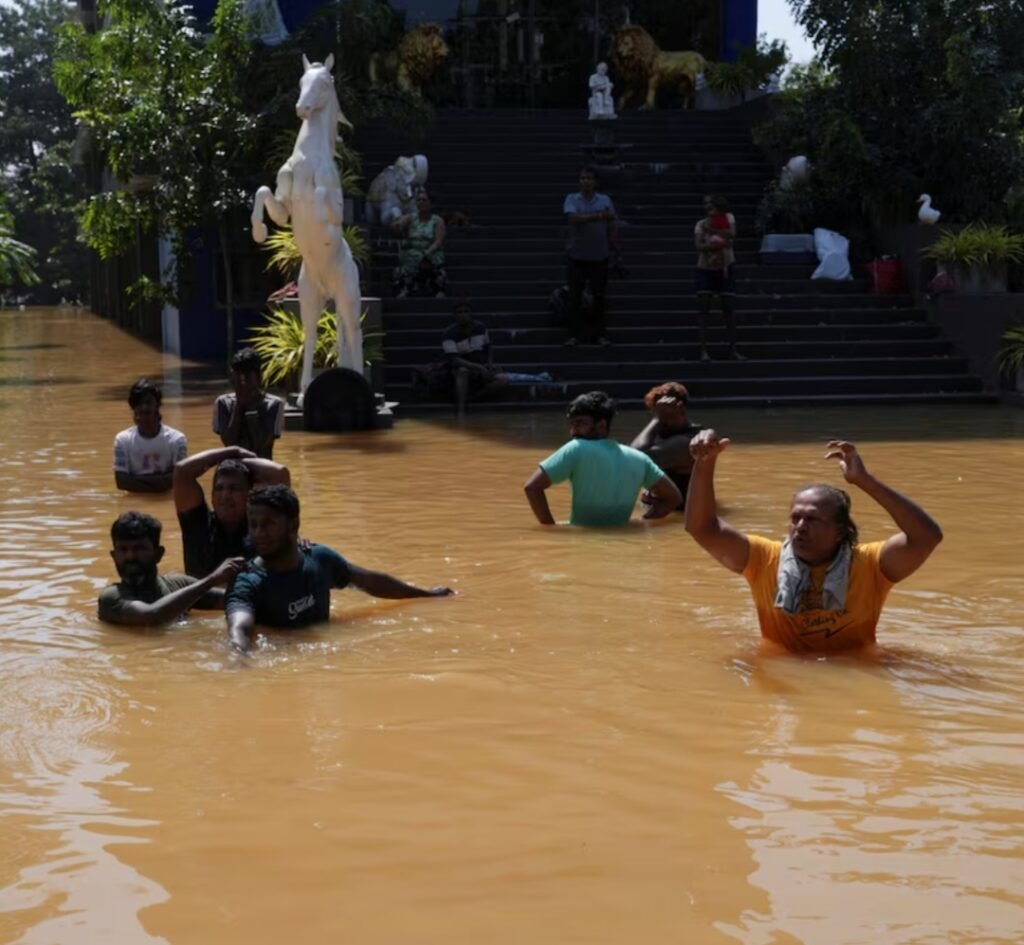
Cyclone Ditwah made landfall around 27–29 November 2025, bringing torrential rain that triggered massive flooding and landslides across several provinces in Sri Lanka. As of 2nd December, 1.4 million people from over 407,594 families across all 25 districts have been affected, 410 confirmed deaths, 336 people remain missing, and nearly 233,000 people have been displaced into almost 1,441 active shelters, and 565 houses have been fully destroyed and over 20,271 partially damaged. In areas surrounding the capital, flooding caused by rivers such as the Kelani River led to widespread inundation, with many homes submerged and entire neighbourhoods left without electricity.
The severity of the disaster prompted the government to declare a state of emergency, allowing rapid mobilisation of rescue and relief operations involving military, navy, and police forces. The confluence of heavy rainfall, landslides in hilly regions, and flooding in low-lying areas highlighted the scale and multi-dimensional nature of the calamity.
India’s Immediate Humanitarian Response.
As one of Sri Lanka’s closest neighbours and long-standing partners, India responded promptly via Operation Sagar Bandhu. The Indian Air Force (IAF) deployed transport aircraft — a C-130J and an IL-76 — which delivered approximately 21 tons of relief material, including food, hygiene kits, tents, tarpaulins, and other essential supplies to Colombo. Over 80 personnel from the National Disaster Response Force (NDRF) were included in the mission, along with 8 tons of specialised relief equipment.
Naval vessels — including INS Vikrant and INS Udaigiri — delivered additional consignments of dry and fresh rations and other survival essentials. The initial batches included 4.5 tons of dry rations and 2 tons of fresh food supplies. The IAF and Indian Navy also deployed helicopters to assist with search-and-rescue operations, evacuations, and delivery of relief to cut-off or remote areas.
The Indian High Commission facilitated evacuation assistance for stranded citizens, while the Indian government expressed diplomatic solidarity — with public statements reinforcing India’s “Neighbourhood First” policy and reaffirming its readiness to assist Sri Lanka in recovery. This rapid and multi-modal response underscores India’s capacity and willingness to act as a first responder during major crises in the Indian Ocean region.
Cyclone Ditwah in the Broader Context of India–Sri Lanka Relations.
While the aid during Cyclone Ditwah was humanitarian in nature, it must be viewed against the wider backdrop of India–Sri Lanka relations, which encompass strategic, economic, and sociocultural dimensions.
Historical Role as First Responder
India has repeatedly extended aid to Sri Lanka during natural disasters and crises: from the 2004 Indian Ocean tsunami to recurrent floods, landslides, and the 2022 economic crisis involving fuel, food, and medical supply shortages. Cyclone Ditwah continues this pattern of India acting as Sri Lanka’s closest and most dependable crisis-response partner.
Strategic and Geopolitical Implications
Sri Lanka occupies a strategically significant position in the Indian Ocean, a region increasingly shaped by competition among major powers. India’s swift humanitarian assistance reaffirms its role as a regional security provider and enhances its soft-power standing. In doing so, India advances its long-term objective of maintaining stability and influence in its maritime neighborhood.
Moreover, effective disaster-relief cooperation strengthens bilateral maritime and security ties — offering a platform for future collaboration on coastal resilience, search-and-rescue (SAR) frameworks, and coordinated responses to climate-induced disasters.
Maritime Security and Regional Cooperation
Cyclone Ditwah highlights the importance of shared maritime infrastructure, early-warning systems, and coordinated disaster preparedness for island and coastal states. India and Sri Lanka already cooperate through regional mechanisms such as multilateral naval exercises and maritime-security arrangements.
The urgency of post-cyclone reconstruction and disaster risk reduction may accelerate cooperation in the areas of climate-resilient coastal infrastructure, hydrological monitoring, early-warning systems, and a joint humanitarian assistance and disaster-response framework. This cooperation could be institutionalised under broader regional initiatives, reinforcing mutual dependency and enhancing resilience against future environmental shocks.
Economic Relations and Reconstruction
As the country enters recovery and rebuilding, India could play a significant role in infrastructure reconstruction, where it could restore supply chains, transport and electricity network, as well as support the agricultural recovery and food security through facilitating bilateral trade and investment recovery. These efforts could revitalise aspects of economic cooperation, including trade under existing frameworks, and open new opportunities for collaboration in infrastructure and development projects.
Challenges and Sensitivities in the Bilateral Relationship.
While India’s aid response strengthens relations, several challenges and potential tensions merit attention; such as (a) domestic political sensitivities in Sri Lanka as relief and reconstruction can be politically sensitive, especially in areas with strong local identity or nationalist sentiments, (b) public perception and geopolitical narratives because some social segments may view external assistance through a lens of strategic competition, especially in light of Sri Lanka’s existing ties with other powers, (c) equitable distribution and transparency of aid which requires to ensure relief reaches the most vulnerable with the government and inter-governmental coordination, and (d) sustainability and resilience focus to ensure long-term recovery priorities giving disaster-risk reduction, resilient infrastructure, climate adaptation and environmental safeguards to prevent recurrence. Balancing humanitarian urgency with long-term development goals and diplomatic sensitivities is essential.
Opportunities for Strengthening Bilateral Relations
The Cyclone Ditwah crisis also opens pathways to deepen India–Sri Lanka cooperation in meaningful, long-term ways. Some of them are (a) Climate-resilience partnerships which calls for joint investments in flood defences, coastal protection, early-warning systems, watershed management, and climate-smart agriculture, (b) maritime cooperation to expand disaster-response capacity, shared SAR mechanisms, and coordinated naval-civil response frameworks for emergencies, and (c) Infrastructure and reconstruction collaboration with Indian assistants in rebuilding roads, power, transport, and housing — blending relief with development. In this sense, India’s response goes beyond mere emergency relief — it may lay the foundation for deeper regional cooperation and resilience amid growing climate risks.
Conclusion
Cyclone Ditwah has exposed Sri Lanka’s acute vulnerability to extreme weather events, adding pressure to its fragile social and economic fabric. Yet in this time of crisis, the strength of India–Sri Lanka relations has been clearly demonstrated. India’s swift humanitarian response under Operation Sagar Bandhu underscores its role as a first responder and committed neighbour in the Indian Ocean region. Beyond immediate relief, the cyclone presents a critical juncture — an opportunity to reshape bilateral cooperation around climate resilience, maritime security, infrastructure rebuilding, and sustainable development. As the region grapples with increasing frequency and intensity of climate-driven disasters, the strategic and humanitarian dimensions of India–Sri Lanka relations will likely grow even more intertwined.
E. V. A. Dissanayake is an Independent Researcher from Sri Lanka. She is a Robert Bosche Stiftung Fellow and a Visiting Scholar of Columbia University, USA.