
25 August 2026, NIICE Commentary 12572
Dr Chander Shekhar
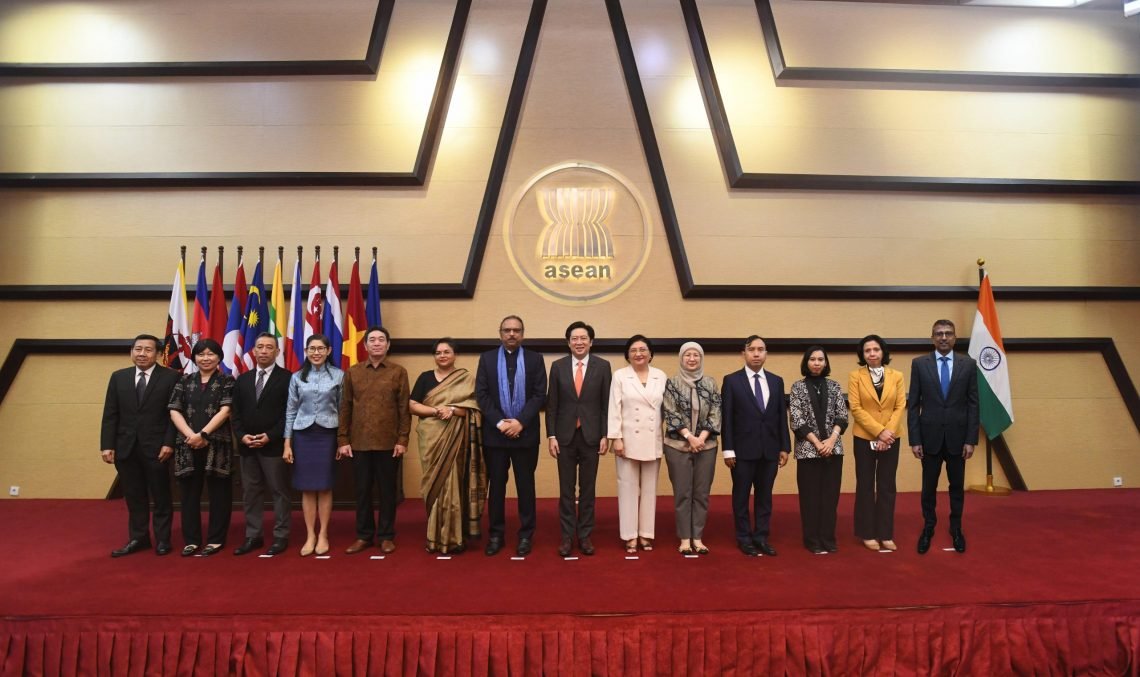
In the midst of a world facing multiple shocks, from regional wars to supply side disruption make countries to think away from box to secure the supply of crucial goods and to protect interest; they are reinforcing existing ties with partner countries. From Europe to the Middle East, and potential crisis have exposed the vulnerabilities of countries dependent upon narrow waterways, and diversified supply and protect future disruption for mutual benefits, thereby making the process rather punishment for global south region’s aspiration of peace and development through inclusive cooperation and prosperity. The Republic of India and the Association of South East Asian Nations (ASEAN), being two oldest partners and member of Global South embraced diversity, have realized the past miscalculation and strategic blunder of countries affecting Asia, Africa and Latin American regions, set to move by reinforcing stronger collaboration and cooperation in maritime sector to achieve “a more stable and secure future” from potential threats. The ASEAN-India have cemented their partnership in maritime affairs over years to deal with transnational crimes, piracy, natural disasters, geopolitical balancing. The 2nd upcoming ASEAN-India Maritime Exercise (AIME), which marks a watershed moment in the region as China’s peaceful rise make countries suspicious, has been scheduled in next month September, 2026, would further upscale their contemporary ties and set a model of practical cooperation without military alliance.
Maritime Gaining Currency
Last couple of decades have seen a gradual rise in maritime sector and its geo-economic relevance, this is because of maritime cautiousness although the uses of ocean are there for centuries as of how countries were discovered and famous voyages by people to connect, trade and explore the world. It is believed that sea carries over 80% of international trade volume in number which is growing year on year. In the last few years, this sector has been under trouble. The Suez Canal, Red Sea and Panama Canal have faced geopolitical tensions forcing countries to rerouting the ships from Africa’s Cape of Good Hope. Reports suggest that in the mid-2024 the ships transiting via Suez fell down, and tonnage crossing the canal cut by 70%, as a result there was around 89% surge in Cape of Good Hope, which increased both transportation cost and time, and further affected food security, energy, fertilizers and global economy. Likewise, the Middle Eastern conundrum has traumatized international community, not just in the scale of its repercussions, but its durable deep affects forcing countries to move towards alternative energies. Most vulnerable countries, residing in global south are exposed to price shocks in oil, natural gases, food and its ripple effects in other sectors.
Having said that, overall the seaborn global trade is witnessing under pressure as well, it is anticipated that as trends show after a 2.2% growth in 2024, maritime trade is about to further declined to 0.5% in 2025 and between 2026-2030 the trade is set to be average at 2%. So, there is a need to strengthen international cooperation to enhance resilience, stabilize trade routes and minimize disruption from climate, transnational crimes or geopolitical tensions.
The impacts of these disruption on India and the ASEAN are critical as they are home of billions dependent on natural energy and other goods outside the region via oceans. India roughly imports 80-90% of its crude oil requirement from Strait of Hormuz (SOH) linked Persian Gulf countries like Saudi Arabia, Iraq, Kuwait, etc, the SOH is not just another chokepoint, but a backbone of international economy and lifeline for energy like India and Southeast Asia. On the other side, the ASEAN countries also resulted in growing their import bills, declared national energy emergencies, prices of oil and diesels up 100%, and seen cooperating each other in reciprocity such as Laos and Thailand’s energy dependence to each other.
So, India and the ASEAN’s growing dependence on secure and safe ocean are critical for their economies. Oceans are interlinked with India and ASEAN’s future aspiration and development.
ASEAN-India Maritime Cooperation 2026
The year 2026 marks a tipping point in ASEAN-India equation vis-à-vis the unfolding situation in the South China Sea and the Asia-Pacific region is concerned. As part of the celebration, they are holding 2nd ASEAN-India Maritime Exercise from 28 September to 02 October, with Subic, Zambales as main venue. It is more than a naval exercise, which is about to happen at a time the South China Sea issue and Asia-Pacific region is in flux with great power rivalries. This year also the Permanent Court of Arbitration’s historic verdict on the South China Sea completes its 10th anniversary which does not recognize China’s historical rights claims, and however, rejected by the latter as favouring Manila without due process.
With the theme of “Anchored in Trust, United at Sea”, the navies of both ASEAN and India would act as balancing so the region could not get into an open rivalries between claimants, with China, United States and other emerging countries. Further, the event intends “to improve maritime security cooperation, coordination, interoperability”, and commanders of different countries get aware of procedures, operational methods and communication.
Beyond military, the South China Sea and its surrounded water is the life line of these countries as they import majority of their resources from other regions. The protection of shipping route, seafarers and blue economy are major focus of this exercise. This year’s maritime exercise is based on 2023 First AIME, which was the successful experiment to build foundation and converted into an organized mechanism for regional commons. However, China sees this drill as “gesture politics” and “attempts to incite more tension” in the South China Sea, so needs to be avoided by concerned stakeholders.
India and the ASEAN needs to work on three points for shaping new trajectory of their maritime cooperation: build a stronger collaboration in maritime security and cooperation, institutionalizing ASEAN-India maritime dialogue mechanism and India to support ASEAN’s East Sea issue.
Conclusion
ASEAN-India’s maritime cooperation is one aspect of their broader Comprehensive Strategic Partnership (CSP). They cover vast gamut of areas that include trade, technology, investment, AI, talent, green, sustainability, mobility, connectivity, etc. Both need to deepened the cooperation to achieve “de-risk and diversify” and act as proactive-balancing to avoid hegemony by any great power in the region. Their interest is confluence in maritime security. India and the ASEAN also share Indo-Pacific vision based on inclusivity and practical cooperation, and reject block politics has short-lived in past lessons, so opened for cooperation and collaboration for global common.
Dr Chander Shekhar is an Assistant Professor at the Akal University, Punjab, India.
