18 October 2026, NIICE Commentary 12793
Dr Chander Shekhar
Geography has evolved, not just a distant space as it used to be seen earlier, but an interconnected shared domain between stakeholders that is deeply connected with the global community. Events occurring at one spot could have far-reaching spillover effects, which shall not be overlooked, as geographies are intertwined. Iran’s survival in the Middle East and its energy shocks, as the United States influenced global oil market prices, explicitly affected economies of the Global South, especially their requirements for food, fuel, fertilizer, etc. Among others, the Arctic space, which remained a limited group of countries, has undergone a transition by including Global South countries and their priorities, looking upward for economic prosperity and energy interests.
This was visible in its latest Arctic Circle Assembly Meeting, which took place on 8-10 October 2026. During its three-day gathering held in Reykjavik, Iceland, the forum covered more than two thousand participants, 200 independent sessions, and 700 speakers from over 70 countries, placing the region as a major priority like the Indo-Pacific, Indian Ocean, etc. The Arctic Circle unpacks the diverse visions, often contested and pushed by great power rivalries from the council members and its observers, they agreed on practicing a collective approach to climate degradation and global warming, melting ice, changing shipping routes, and affecting indigenous communities.
Arctic Region as Rising Geopolitical Hotspot: From Contest to Cooperation
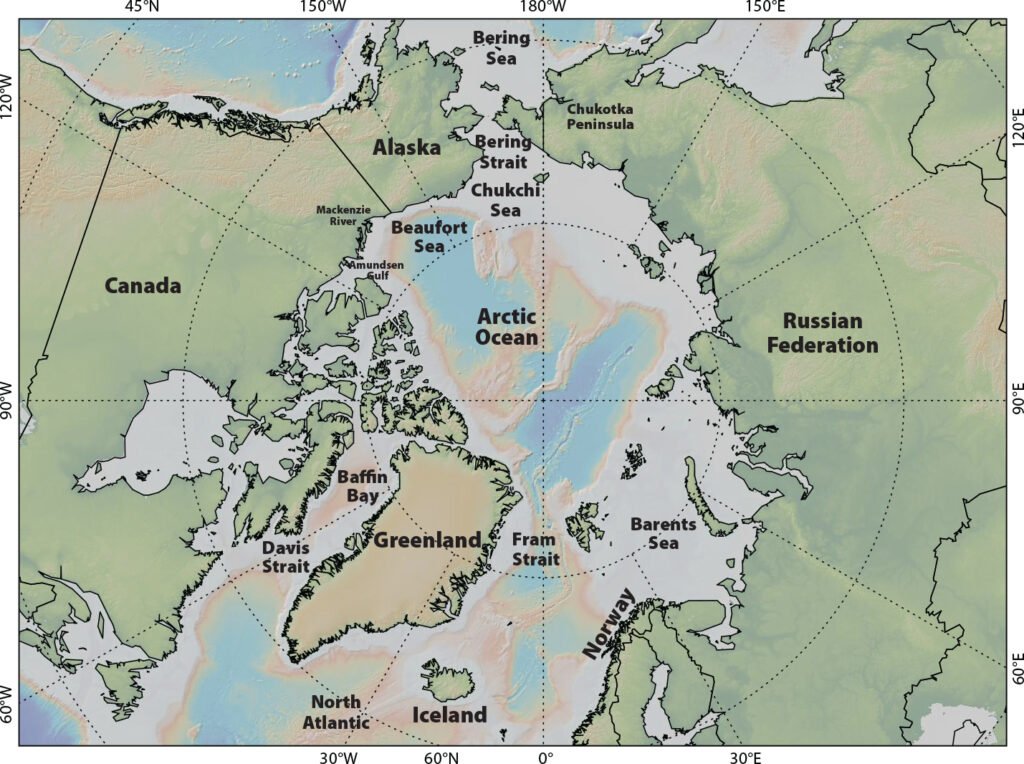
The Arctic region has a strategic maritime route, which links several economic power centres across East Asia, Western Europe and North America. It is generally seen as the shortest strategic maritime route from East Asia to Europe. Recently, this region is in confluence of three major developments, as noted by Esther Brimmer: shifting geopolitics, changing climate and the effects of Russia’s invasion of Ukraine. The Arctic is a construct, US believes it is its “fourth coast,” connecting its strategic, economic and other interests. The gravity of the Arctic region has changed after Russia’s war with Ukraine. As a result, two formal neutral states (Finland and Sweden) applied for NATO (North Atlantic Treaty Organization) membership, which changed the geo-strategic sentiments in the region.
Arctic route and its resilience are seen an important gateway for several countries, such as China. Since its first voyage in 2013, China has significantly multiplied its shipping operations. It has inaugurated its first cargo service via the Arctic route. Now more than six Chinese shipping companies are set to planned 29 vessels to operate 44 Arctic voyages in the year of 2026. Reports indicate that China is utilizing this shipping route for its different categories of ships, such as LNG, container, bulk, multipurpose, and semi-submersible vessels. West believes that China, along with Russia, has military intentions. China discards this by claiming that it “never has any military deployments in the Arctic”. However, in its 2018 Arctic Policy White Paper China calls it as “near-Arctic” state, and in 2013 several major rising economies and political powers became its observers member. Besides, Canadian Foreign Minister Anita Anand also participated in the Arctic Assembly with the aim of strengthening its work with regional partners and with Iceland. Ottawa made it clear that “a stable and well-defended Arctic” is the primary condition for trade, investment, and for people who reside there.
India and the Global South
India and the Arctic are not located in different poles, but their geographical connection and culture could be traced back to a century. It was the Svalbard Treaty, signed on 9 Feb 1920 in Paris; India was a founding signatory to this treaty, which grants the right to access the region. This treaty provides signatory members with access to and engagement in economic, scientific, and commercial activities in the region. After the 9/11 terror attacks, India’s engagement with the Arctic began in 2007 with its first scientific expedition to study the region’s geology, climate, etc. The Indian representative at the Arctic Circle Assembly stated that India’s approach is that “we are geographically distant, but scientifically connected. We are an observer, but seek to be an active and constructive one, as the Arctic is not an isolated region, but an important part of the Earth system”.
In this process, along with China, India established its first Indian Research Station in 2008, which is famously known as Himadri, connecting the Himalayas and the Arctic geographies together as global warming as its effects on ice melting, changing coastlines and shipping routes have strong effects across geo-culture and geographies. Moreover, in 2016, the northernmost atmospheric laboratory became active. In 2022, India launched its Arctic policy with the determination that its approach will be “multidimensional” and commits that “all human activity should be sustainable, responsible, transparent, and based on respect for international laws”. The purpose of its engagement is to build a cooperative and inclusive partnership for sustainable development.
India presents a future direction for its long-term aspiration to be part of the region by employing six pillars: first is to reinforce cooperation in scientific research; second is to deal with climate and environmental protection; third is to stress on economic and human development; fourth is to underline and increasing connectivity; fifth to deepen transportation cooperation; sixth is to place good governance and international cooperation between entities; and seventh is to build national capacity for the Arctic region. These pillars are comprehensive in nature and wide in scope; they do not favour militarization or bloc politics, but a shared space for a shared common future. India’s institutionalized ties in the Arctic space through holding an observer status in the Arctic Council make it a strategic player in its governance and security.
Conclusion
Arctic region is set to emerge as a rather tumultuous route, unlike other troubled narrow waterways. This is poorly highlighted by pundits as a potential zone of confrontation and opportunities. West’s careful voyages are needed to manage complex entities seeking to establish their avenues to dominate the geo-space. The emerging advancements have changed the present realities by newly emerged economies and the West needs to be accommodating by expanding its cooperative regimes with the Global South region. China, India, Russia and others have joint responsibilities to preserve the international waters around the Arctic shipping lane and develop capacities to handle climate challenges. India’s upward approach in the Arctic needs to be mounted up and manage multiplex challenges in this trans-connected space.
Dr Chander Shekhar is an Assistant Professor at Akal University, Punjab, India.