
19 September 2026, NIICE Commentary 12744
Dr Chander Shekhar
Global South has emerged as an important player in the unfolding geopolitics of the international order. The developing countries, which have come together to raise voice to reforming global governance structure, have been facing challenges since they got independence which have multiplied in recent decades and so, specially afterwards of global repercussions of COVID, Ukraine crisis and the Iran challenge. These major events have spread shock waves across the regions of developing countries, affecting their economies, people, energy, trade, fertilizer, technology transfer, debt burden, and navigating a complex mix of situations to achieve growth, development and prosperity.
The Trump’s divisive posturing has not just abandoned itself from its past global leadership, but also created room for mutual cooperation between developing countries, and those who, especially long-term partners, are tired of pivoting towards the United States, now finding pathways to cooperate with the global south countries, specially the developed nations which are looking beyond the Trump phenomena. Over decades, the developing countries have been left at the mercy of developed countries' assistance, now this trend has changed as new global governance architecture, not intended to replace the existing ones, is unfolding through institutional mechanisms, such as the BRICS, AIIB, G20 Plus African Union, and others. All these developments have grown in substance and are presenting a model of collective rise. The Global South is tangibly seen growing upward as shared interests and common development goals shape their policy across the region.
Global South Community: A Model of ‘Collective Rise’
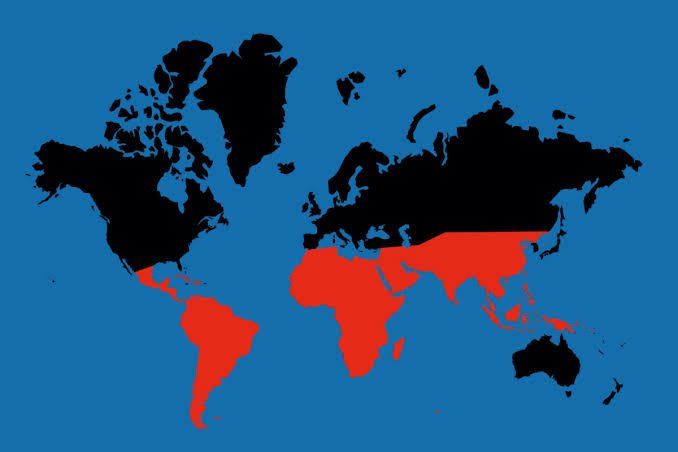
Global South is a buzzword, which is believed to have emerged in the mid-20th century, and came about as a critique of the domination by developed countries. It is generally seen as a gathering of developing countries situated in Asia, Africa, Latin America, the Caribbean, and Oceania. These regions share a history of colonialism and imperialism, and now dependency and subjugation of economic resources. The Global South is a framework that provides an apt choice for different regions to write a common development trajectory and shape inclusive growth.
The grouping is navigating common issues of inequalities, power imbalances, underdevelopment, etc. It was noted during the 18th BRICS Summit in New Delhi that “the global south today is seen in the front row of global crises, but in the back row of decision-making”. This needs to be changed. BRICS is committed to changing this trajectory from a “pyramid of privilege” to a “platform of partnership”. This forum has advanced and broadened its geopolitical reach, expanded its agenda, and is significantly seen as the collective rise of the Global South. Further, there is enough potential in this dynamic forum to shape a ‘plural international order’ by redesigning the present international order, monopolized by the developed world, into an inclusive and broadening as per time.
The Asian Infrastructure Investment Bank (AIIB), which reflects the needs, voices and aspirations of the Global South, and the New Development Bank are two classical models of the Asian approach to finance infrastructure development and pushing South-South cooperation in alignment with the Sustainable Development Goals. To deal with COVID-19, developing countries fought together. India led initiatives, ranging from vaccine diplomacy and renewable energy to digital public infrastructure and global development compact are some measures as global common good and as alternative paths for shared development. Whereas China’s initiatives, such as the Global Development Initiative, Global Security Initiative, and Global Civilization Initiative, have played crucial roles in the developmental journey of the Global South region.
Mechanisms, such as the BRICS and the G20 Plus African Union, have emerged as a platform for cooperation in the Global South region, wherein the excluded African states in the past have now become active and visible players moving “from being subjects of global governance to becoming shapers of it”.
India’s growing reach and reinforcing centrality of Global South
India’s Global South engagement is deeply associated with its historical memories, colonial struggles, mutual aspiration and growth for self-reliance and, is one of the influential countries in the grouping which evolved its role initially as the founding member of the Non-Aligned Movement, South-South cooperative framework, the later is refined as the Global South in the First Voice of the Global South Summit in Jan 2023 and its successful efforts to include the African Union in the G-20 Summit. India’s tangible cooperation with the Global South countries is visible and witnessed upward in its economic ties, investment, development assistance, capacity building, international solar alliance, etc. So, in India’s development and growth journey, the Global South is at the centre, and while addressing issues maintain centrality of the organization.
Over the years, India has emerged as “a confident and credible voice of the Global South”, which shapes the nature of global conversation and makes a quality contribution to a balanced and inclusive world order.
Under India’s BRICS 2026 chairmanship, the concerns and issues of developing countries were highlighted, and the focus was expanded to climate finance, global supply chains, carbon markets, and adaptation among developing countries. At the 2024 BRICS Kazan Summit Moment, the Chinese President stated that “the global south emerges for development and prospers through development, we should make ourselves the main driving force for common development”.
Conclusion
The present world order is in turmoil: the Global South nations face an unprecedented situation to deal with, along with their domestic, economic, political and social conditions. The grouping needs to reinforce its mandate, mechanisms of conversation and dialogue, strengthening mutual learning to avoid misunderstanding for a common future. Since the World Wars, India has been committed to leading the developing countries in the fight against colonialism and imperialism, this was done through a collective approach as countries facing common issues. On the other hand, China coexists with the rising powers and takes the opportunity to build a long-term partnership for mutual growth and destiny. Global South is a collective responsibility of rising powers.
Dr Chander Shekhar is an Assistant Professor at Akal University, Punjab, India.
