
16 September 2026, NIICE Commentary 12734
Dr Meena Kumari & Dr Vimlok Tiwari
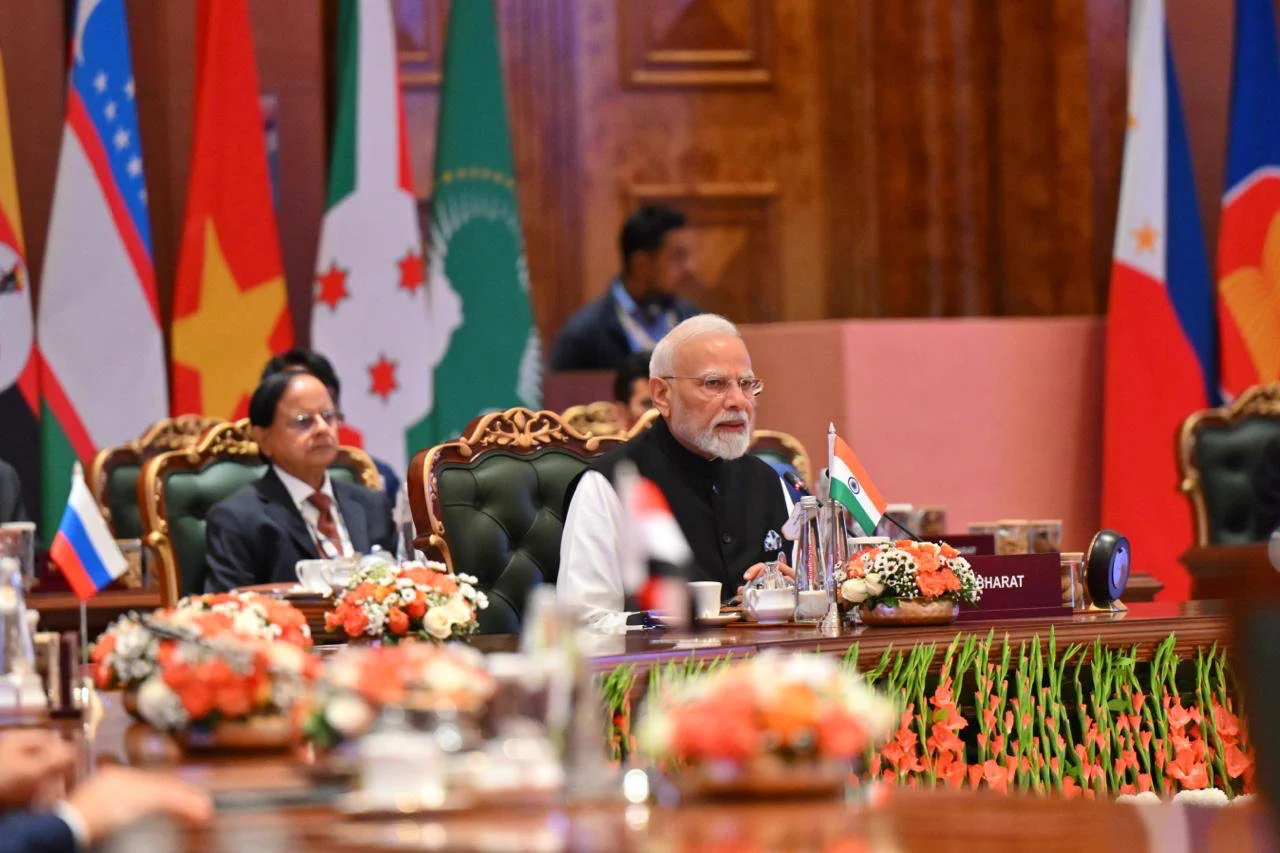
The 18th BRICS Summit and the 140-point Delhi Declaration are expected to be unprecedented not only for the partner countries but for the whole global order. In recent years, precisely in 2024-25, the membership of BRICS has grown and doubled in number. It started, as its acronym suggests, with Brazil, Russia, India (Bharat), and China in 2006, with the addition of South Africa in 2010. With the recent addition of five more countries, namely Egypt, Ethiopia, Iran, the United Arab Emirates, Indonesia and Saudi Arabia, the membership has increased to eleven. Indeed, it has emerged as one of the most powerful groups in the present world order collectively, accounting for around 40 percent of world GDP with half of the world population. All in all, it is a ‘powerpack’ organisation with some of the most powerful nations in the contemporary global order, but not without conflicting, heterogeneous and constantly changing interests. The diverse political and economic interests raises a pertinent question, the question is of the utilization of this platform in the right frame. And in that way, what stood out about BRICS 2026 was not a dramatic announcement or a single headline outcome. It was the quieter, and perhaps more difficult, achievement of getting a diverse group of countries to agree on a common document at a time when the world is becoming increasingly divided. India’s year-long chairship culminated in the adoption of the New Delhi Declaration, bringing together the expanded BRICS membership or BRICS+, on issues ranging from global governance and terrorism to trade and de-dollarization, energy, climate, healthcare, Artificial Intelligence (AI), technology, critical minerals and sustainable development. Though the scope of many issues is limited, the consensus should not be taken for granted.
Civilizational Ethos and Global South Agency
India has leveraged its chairmanship of BRICS 2026 to demonstrate its civilizational ethos and strengthen the interests and concerns of the non-Western countries. The concept of civilization is increasingly becoming prominent in international scenarios, though it remains contested as an analytical category.
Vasudhaiva Kutumbakam (the world is one single family), one of the most used maxims from ancient Indian thought, like the African notion of Ubuntu (“I am because we are”), remains at the center of its foreign policy and diplomatic relations. It clearly depicts a close affinity of India's diplomatic thinking with the traditional ideas coming from ancient thought, along with Buddhism and Jainism, and some of the important texts such as ‘Kautilya’s Arthashastra ’.
The Delhi Declaration is reaffirming this commitment by focusing on ‘fostering inclusive, mutually beneficial and development-oriented partnership with the Partner countries’. It also committed to strengthening cooperation among BRICS nations by addressing the common questions with a more practical, balanced, inclusive and people-centric approach. A broader commitment in this way is to improve and reform global governance and encourage a democratic, legitimate, effective, and accountable system based on shared values and interests. It focuses on the participation and representation of the countries of Asia, Africa, and Latin America
The Delhi Declaration has highlighted the relevance of the Global South as a major driving force for positive change. It will deal with significant global issues such as intensifying geopolitical tensions, technological changes including AI, and the challenges of migration and climate change (the issue becomes even more significant in the context of the recent environmental crisis in Nepal). Thus, BRICS would act as an important player in expressing the interests, priorities, aspirations, and concerns of the Global South. And to protect the interests of member states and the Global South community, it criticises the economic sanctions that are unilateral in nature.
Here, the idea of the Global South is not simply treated as a geographical classification but as a broader contemporary political significance. The term is used as a political vocabulary through which the states can express their worries about representation, development, historical inequality, climate financing, access to technology, and their decision-making role.
The Consensus Building: Towards Inclusivity and Multilateralism
BRICS today brings together countries with very different political systems, economic interests, and strategic priorities under one common broader theme: “Building for Resilience, Innovation, Cooperation and Sustainability”. There are also genuine disagreements among its members on some of the most sensitive geopolitical questions. In such a setting, diplomacy is often less about finding perfect agreement and more about finding language and principles that everyone can live with. India appeared to approach the chairship in precisely that spirit. The emphasis on dialogue, sovereignty, international law, civilian protection and cooperation helped create common ground even on difficult issues. At the same time, India ensured that issues important to the Global South, such as reform of global institutions, greater representation for emerging economies, development, digital cooperation, food and energy security and counter-terrorism remained central to the conversation.
The strong reference to terrorism, including the Pahalgam attack, was particularly significant from India’s perspective. Beyond the declaration itself, the year-long engagement mattered. Meetings across different parts of India, discussions on emerging technologies and AI, development and sustainability, and extensive bilateral interactions showed that chairing a multilateral grouping is not simply about hosting a summit for two days. It is about spending an entire year building conversations, managing differences, and creating enough trust for countries to eventually sit together and agree.
The Diplomatic Capital and the Trust Building
For us, this is where India’s growing diplomatic capital becomes visible. India is increasingly being seen not merely as a country with a large economy and strategic importance, but as a country that can bring different sides to the table, listen to competing interests and still work towards a common outcome. Of course, BRICS remains far from a cohesive political bloc. Its internal differences are real, and the expanded grouping will continue to face questions about its direction and effectiveness. But perhaps that is exactly why the New Delhi outcome matters.
In a fragmented international environment, the ability to keep a conversation going and occasionally turn disagreement into consensus is itself a form of diplomatic power. BRICS 2026, in that sense, was not just about what India hosted. It was about what India demonstrated: the capacity to convene, negotiate, bridge differences and shape the conversation. And that may prove to be the most valuable outcome of all.
Dr Meena Kumari is an assistant professor in the Department of Political Science, Miranda House, University of Delhi, Delhi, India & Dr Vimlok Tiwari is an IRS officer in the Government of India, India.
