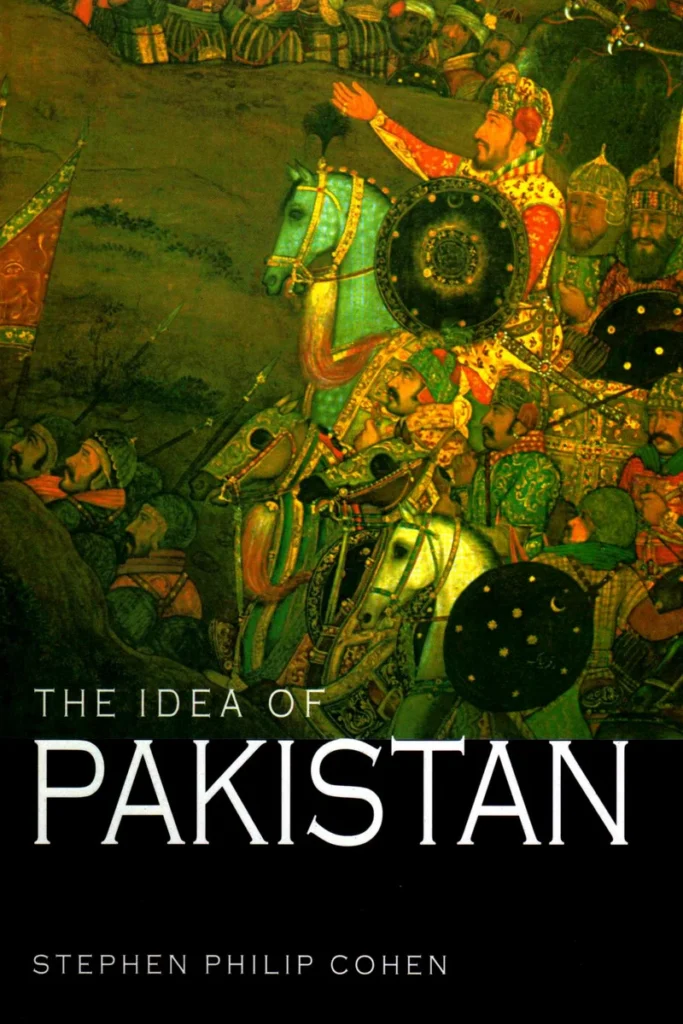
Stephen Philip Cohen (2005), The Idea of Pakistan. Vanguard Books, Pakistan.
Sabeen Azam
 The Idea of Pakistan by Stephen Philip Cohen (Vanguard Books, 2005) is one such effort to address these perennial conundrums of Pakistan Statehood. Cohen, being one of the most prominent experts on South Asia offers an illuminating analysis of the narrative of the past of Pakistan and its political institutions, the relationship between civil and military institutions, ideology, and its future possibilities. The main argument in the book is that Pakistan is a nation in crisis, trying to reconcile between its original concept of a state made of the South Asian Muslims and the reality of governing, securing, and building as a nation. Although the views of Cohen at times illustrate a Western security bias and even a deterministic approach, this work is essential to all scholars and policy analysts who want to get acquainted with the intricacies of one of the most strategically important – and yet the most misunderstood- states of the international system.
Cohen divides his book into a number of thematic excursuses as opposed to a straightforward chronologically-driven history, and this enables him to point out the structural conundrums that have afflicted Pakistan ever since it gained freedom in 1947.
Underlying Conflicts and the Two-Nation Theory
Cohen starts with the origins of the ideology of Pakistan. Based on the two-nation theory formulated by Muhammad Jinnah and the Muslim League, Pakistan was supposed to be a nation of the Muslims of South Asia. Cohen maintains that this ideological birthsynthesized both the source of legitimacy and the source of long-term problems: whereas India could draw upon its own long traditions as a civilization, Pakistan had to define itself largely in opposition to its neighbor India. There is a strong influence on its foreign policy, politics, and self-concept because of this oppositional base.
Civil–Military Relations
The best aspect of the book is discussed by Cohen on civil-military relations. He shows how the Pakistan military, in particular, has always presented itself as the guarantor of national integrity, intervening successfully on multiple occasions to rescue Pakistan supposedly against existential threats or political crises. It has resulted in a vicious cycle; poor civilian institutions give the army opportunities to intervene and intervene in the institutions, with greater weakening of the democratic process. Cohen finds that this militarization of politics has not only distorted its politics but also its economic priorities and also its foreign relations.
Regional and Ethnic Violence
Cohen pays much attention to the ethnic diversity of Pakistan. Since the secession of East Pakistan in 1971 to the present-day instability in Balochistan and quiet resentment in Sindh and Khyber Pakhtunkhwa, the state has not been able to strike the right balance between centralization and federalism. Such divisions as seen by Cohen are not just administrative, but they touch the core of what Pakistan is as a united state.
Religion and Identities
The book also evaluates the controversial place of Islam in politics. Although religion gave a sense of unity before and during the independence movement, Cohen also emphasizes that in post 1947 Pakistan, there are the religiously culturally identitarian views of religion by some and those who insist on more theocratic rule. This fact is complicated by the emergence of religious parties, the Islamization policies of General Zia-ul-Haq, and the proliferation of militant groups that affect political life and the international picture of Pakistan. As Cohen said, religion can be a stabilizing and destabilizing force in the hands of competing groups. Religion can be used to legitimize the state; however, religion can also act to fragment the state.
Foreign Policy and Security
Another pillar of the book is foreign relations. Pakistan has had an enmity relationship with India, especially concerning Kashmir. Cohen also covers the aspects of the nuclear weapons program of Pakistan, its uncomfortable relationship with the United States, as well as its strategic interests in Afghanistan. The paradox of the foreign policy of Pakistan is that, even though it entirely relies on the external powers to provide military and economic assistance, it still develops a platform of sovereignty and resistance.
Possible Futures
The most creative part of Cohen’s book is his exploration of possible futures of Pakistan, where he presents a set of scenarios that encapsulate the uncertainty and fluidity of the future of that country. He envisages authoritarian stability through the maintenance of the Republican Guard, which has been the long-standing practice of the army meddling in politics. On the other end, there is also the risk of Islamic radicalization, where radical factions might seize or strongly establish their control over the state and reform its structures and foreign policy. A more cheerful, but less probable, road is democratic consolidation, possible only when civilian institutions are strong enough to prevail over the military. The occurrence of state failure is also potentially distressing, as internal wrangles, economic ruin, and poor government might overpower the ability of the state to operate. Lastly, the model put forward by Cohen is that of reformist pragmatism, where gradually and slowly, Pakistan would become a more functional and moderate state with adaptations to reforms. Presenting these varied scenarios, Cohen urges readers not to think of Pakistan as remaining the same entity but rather as a nation that finds itself at a crossroads with various possible paths determined by the actions and institutions of Pakistan as well as those of other states and problems.
The merits of The Idea of Pakistan are that it is clear, comprehensive, and novel. Cohen has half a dozen books to his credit, largely concerning the U.S. relationship with the Israeli state. His current one under review is written in an extremely clear fashion and free of jargon, and therefore could be appealing to scholars as well as to policymakers and informed general readers. His integration of history, politics, security studies, and future studies in one work is remarkable and makes it a brilliant presentation of an interdisciplinary reader. Cohen has broadened the understanding of civil-military relations and clearly shown that the construction of the national identity, controlling the state, and even the economic progress are all determined by the military forces of Pakistan. Since Pakistan is the main focus of the policy statement, the section on the possible futures of Pakistan deserves special attention because this aspect of the policy statement is original and useful, as it allows the policy-making community to identify possible and even probable futures and plan the future accordingly.
However, the book does not lack weaknesses. In some instances, through the lens of U.S. strategic interests, Cohen treats the case of Pakistan mainly as Western-centric. This is understandable because of his background; it threatens to conceal indigenous arguments and thought. His explanations can also assume a deterministic character, in that Pakistan has been placed in a mold of failure with little or no chance of adaptation, even though its existence through many crises may have suggested the ability to adapt that his paradigm lacks. In addition, Cohen has an inclination to describe the Islamic religion as mostly a destabilizing force, without acknowledging its societal positive aspects, such as social cohesion, networks of charity, and reformist zeal in the country. The book has made extensive use of secondary sources and policy reviews and analysis, with slight or no interaction with Pakistani intellectuals, culture, and grassroots, which makes it authoritative in one sense and distant in another.
These shortcomings notwithstanding, the strengths of this book are far better than its weaknesses. Cohen’s work is clear, comprehensive, and future-oriented in its analysis, and The Idea of Pakistan will count as a starting point in any practical consideration of the political progress of Pakistan.
At the time The Idea of Pakistan was released in 2005, Pakistan was on everyone’s mind in the world map. The nation was an important ally of the United States in the so-called war on terror after the September 11, 2001, attacks, and was also combating its internal militancy, political instability, and increasingly intense international questioning of its nuclear program. The analysis by Cohen related precisely to these problems and provided a framework through which policymakers can consider the future of Pakistan.
The relevance of the book has survived twenty years down the line. Most of the issues raised by Cohen, such as weak civilian institutions, the authoritative military, extremism, and fragile economies, are at the core of Pakistan. The book also foreshadows topics of discussion nowadays: the dangers of state failure, prospects of democratic revival, and the India-Pakistan rivalry.
Foreseeably, Cohen makes a unique contribution in the context of the sub-discipline of Pakistan studies. Contrary to Anatol Lieven’s Pakistan: a hard country (2011), which has more of an ethnographic and society-centered direction, Cohen is more strategic and state-centered. By contrast with the historical studies written by Ayesha Jalal on the partition and nationhood of Pakistan, Cohen is less concerned with historical subtleties and more interested in the present-day policy outcomes. This makes the book particularly useful to policymakers and anyone internationally interested in having a general, more popular take on what is happening in Pakistan and the dilemma it is experiencing.
Personally, reading The Idea of Pakistan was, at the time, enlightening as well as upsetting. Cohen analysis allowed me to recall the structural difficulties that Pakistan encounters- difficulties not only linked to governance failures but also on the premises on which the state was being founded. His discussion of civil-military relations was especially impressive in bringing out the reason the democratic experiment in Pakistan has failed on multiple occasions.
By the same token, I also felt that the book does not emphasize the resilience of Pakistan enough. Pakistan has time and again survived, evolved, and restructured itself after repeated crises in the shape of wars, military coups, economic implosions, and international isolation. Cohen does not disagree with this strength but tends to describe it as an occurrence of chance rather than systemic. I also felt that I needed more Pakistani voices in the text: writers, thinkers, activists whose voices could have offered a counter to the outside view of a Western expert.
Compared to other books, the one by Cohen is more acute at strategy, yet sparser when it comes to the social and cultural context. Another good example would be Lieven, Pakistan: A Hard Country, which represents a more realistic picture of the resiliency in the Pakistani society. However, the book of Cohen has the merit of foresight and has produced scenarios that sustain discussions on the issue of Pakistan.
The Idea of Pakistan by Stephen Philip Cohen has turned out to be a groundbreaking work, which has been in use for nearly 20 years after it was published. It is analytically unambiguous, and its explanations on the ideological genetic composition of Pakistan, civil-military disproportion, ethnic divisions, and foreign policies offer clear-cut insights about the historical course of the state. Although the book reflects the limitations, such as a West-centric prism and a lack of indigenous voices, it is a must-read among academicians, policymakers, and international readers who want to understand the makeup of a controversial nation like Pakistan.
Finally, The Idea of Pakistan is a historical retrospection and a prognostic message. It forces readers to contend with paradoxes of a state based on an idea which has yet to find in the plus side of the balance a stable synthesis of ideology and government, of selfhood and safety. The book would prove to be a must-read for students of South Asia, international relations, and comparative politics. To policymakers, it provides a serious lesson that the problems in Pakistan are systemic and need a subtle approach. To the general reader, it offers entry into a story of a nation whose destiny has come to have such an impact on the politics of the region and the world.
Sabeen Azam is a PhD, Fellow of International Relations at the Federal University of Arts, Science and Technology, Pakistan. She can be reach out on cliquish.hansell786@gmail.com