
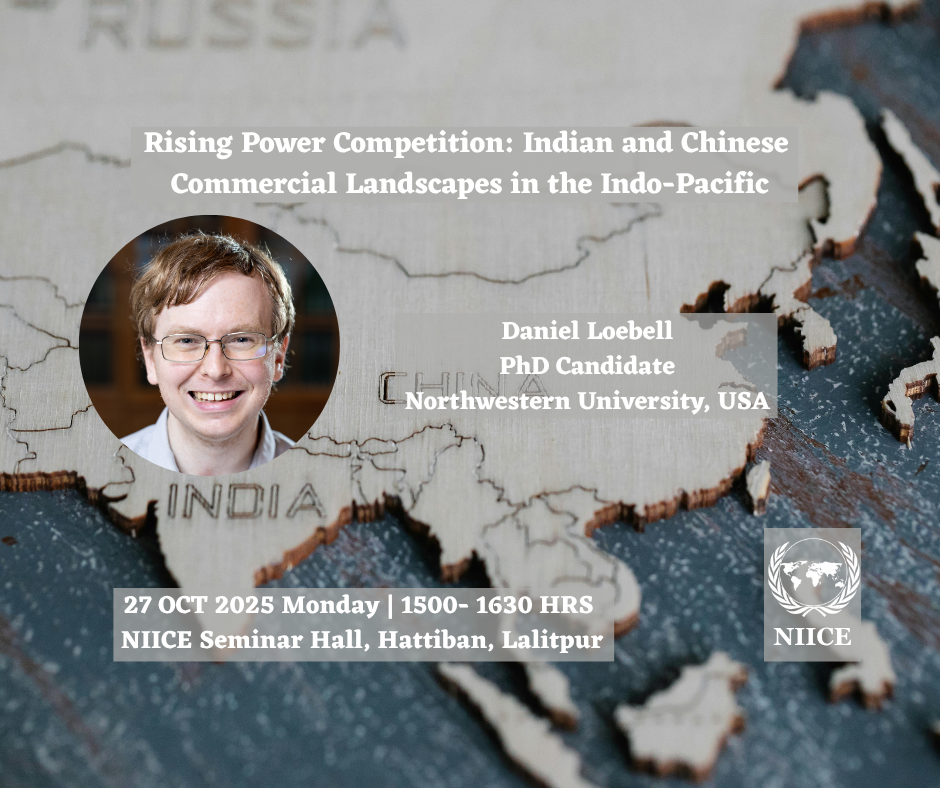
Rising Power Competition: Indian and Chinese Commercial Landscapes in the Indo-Pacific
Watch the full session on our YouTube Channel
The keynote speaker, Daniel Loebell, a Ph.D. candidate at Northwestern University, specializes in small-state hedging under China’s Belt and Road Initiative (BRI), investor-state arbitration, and Asia’s political-economic engagement with China and India.
The moderator opened the event by highlighting Nepal’s potential inclusion in the Indo-Pacific discourse despite being landlocked. Through its open border with India, Nepal maintains virtual maritime access to the Indian Ocean, linking the Himalayas to the larger Indo-Pacific strategic framework. This framing positioned Nepal as a crucial continental connector within the maritime competition of major powers.
Overview of Daniel Loebell’s Presentation
Daniel Loebell began by expressing gratitude for delivering his first academic talk in Nepal. He contextualized his presentation within his ongoing field research, supported by the Northwestern Buffett Institute for Global Affairs, where he conducted over 40 semi-structured interviews across Nepal’s public, private, and academic sectors.
His core research question explores how commercial actors, corporations, investors, and non-profit institutions, shape perceptions of power and hegemony in small states such as Nepal and Malaysia. The lecture, he emphasized, was an exploratory overview of his broader comparative project that will continue with fieldwork in Malaysia in early 2025.
Rethinking Power in the Indo-Pacific
Loebell contrasted India’s “Neighborhood First” and “Act East” policies with China’s repeated rejection of “hegemony.” While Prime Minister Modi frames India’s leadership as cooperative regionalism, President Xi Jinping projects a moral, anti-hegemonic image rooted in Chinese political tradition. Loebell linked both narratives to the 1955 Bandung Conference, where newly independent Asian and African states emphasized non-alignment and self-determination.
He argued that modern rising powers echo Bandung’s ideals not through ideology but through economic connectivity and commercial influence. Both India and China, he said, compete to offer models of development that appear benevolent yet still assert strategic reach across South and Southeast Asia.
Commercial Actors and Influence
A central theme of Loebell’s lecture was the notion of “commercial landscapes.” He proposed that geopolitical influence in the 21st century increasingly relies on private and semi-public economic entities, companies, investment funds, and development organizations, that act as instruments of state influence.
Drawing on historical analogies such as the British East India Company and the United Fruit Company, he showed that commercial power has long been intertwined with imperial expansion. Today, India and China project influence through similar mechanisms: trade, investment, education, and infrastructure.
Loebell’s interviews in Nepal revealed that India’s commercial presence remains more pervasive and tangible than China’s. From hydropower and cross-border trade to higher education and NGO partnerships, Indian institutions remain deeply embedded in Nepali society. In contrast, China’s BRI projects, like Pokhara International Airport, symbolize ambition but also expose limits caused by bureaucratic hurdles, environmental disruptions, and India’s diplomatic resistance.
Recent Developments and Political Context
Linking his research to contemporary events, Loebell reflected on the September 2024 Gen Z protests in Kathmandu. He noted how international speculation quickly blamed US foundations for funding the movement illustrating, he said, the “enduring baggage of global hegemonic reputations.”
Even when local grievances drive unrest, global powers such as the US remain symbolic reference points. This observation, Loebell argued, demonstrates how reputational legacies from the Cold War continue to shape perceptions in smaller states, complicating efforts to interpret foreign influence objectively.
Loebell also discussed India’s cautious posture toward Chinese infrastructure projects in Nepal, such as its refusal to allow Indian airliners to use Pokhara’s airspace and reluctance to buy electricity from Chinese-assisted hydropower plants. These examples show that India’s strategic behavior often constrains Nepal’s economic autonomy, even when Chinese investments appear more limited.
Nepal–Malaysia Comparison
Explaining his comparative design, Loebell said he chose Nepal and Malaysia because both have long-standing cultural and commercial ties with China and India. Historically, Malaysia’s Kedah city-state maintained trade with China under the Song Dynasty via Tamil Nadu’s Chola Empire, while Nepal historically mediated exchanges between India and Tibet.
He also emphasized a modern socioeconomic link: Nepali migrant labor in Malaysia and the resulting remittances that sustain Nepal’s economy. Citing Nepali economist Sujeev Shakya’s “Nepal 2043”, which draws inspiration from Malaysia’s Vision 2020, Loebell noted how Malaysian development models influence Nepali policy thinking. Both countries, he said, demonstrate how small states navigate economic interdependence within a contested Indo-Pacific order.
Question and Answer Session
The interactive discussion deepened the session’s practical relevance.
Major General Asa Bahadur Tamang (Retd.) asked how Nepal could derive benefits from both India and China despite being landlocked. Loebell responded that Nepal should expand people-to-people diplomacy and civil-society cooperation with both powers. He recommended pursuing balanced partnerships in hydropower, tourism, and education while ensuring independence from coercive measures such as India’s 2015 fuel blockade.
A representative from the Chinese Embassy questioned the future of BRI projects in Nepal. Loebell explained that while official BRI implementation remains politically contentious, Chinese commercial participation will likely grow informally, through bilateral deals and private ventures. Even without formal BRI designation, he said, such projects represent the practical continuation of China’s connectivity agenda.
Brigadier General Ramchandra Kapri (Retd.) raised the issue of geostrategic balance and national security. Loebell emphasized that Nepal’s geography makes it a “bridge between continental and maritime zones of competition.” He argued that recognizing the influence of commercial actors is crucial to maintaining political stability, as these non-state forces increasingly affect governance, investment, and public perception.
Conclusion
Daniel Loebell’s lecture offered a timely reassessment of how power and reputation operate beyond the military and diplomatic realms. By foregrounding commercial actors, his research expands the understanding of influence in the Indo-Pacific from state-centric competition to everyday economic engagement.
For Nepal, Loebell suggested, the challenge is to convert its geographic vulnerability into strategic versatility balancing between India’s proximity and China’s opportunities while avoiding over-dependence on either. This requires pragmatic foreign policy and long-term vision focused on sustainable partnerships rather than short-term political alignment.
The event concluded with closing remarks from NIICE representatives, who praised Loebell’s analytical depth and cross-regional perspective. His work illuminated how rising powers build legitimacy not only through diplomacy but through the subtle, persistent presence of commerce and connectivity in the lives of smaller nations.
Recent Comments